
In association with The Law Society Gazette
Published on 8 November 2024
Bond Solon is delighted to publish this year’s expert witness survey in collaboration with the Law Society Gazette. It was conducted online from 5 September 2024 to 30 September 2024 and 537 experts contributed.
The Gazette is a weekly legal magazine for solicitors in England and Wales, published by the Law Society of England and Wales. It is provided to all solicitors with a current England and Wales practising certificate, as well as trainee solicitors. It has by far the highest audited circulation of any legal journal in the UK, as well as the largest circulation for a legal magazine in Europe.
The survey looks at improving standards of expert evidence including the independence of experts, instructing the right expert, sanctions, mentoring and the professional relationship with solicitors. It also looks at new methods of working, including AI, remote evidence giving, and finally, fees. Some of the responses are set out as a percentage and others have a commentary and the detailed comments of the respondents.
I do hope you find the results of interest and do feel free to email me if you have any further thoughts.
Mark Solon
experts@bondsolon.com

The duty of the expert is to the court, not the paying party that has instructed the expert witness.
They must also possess the skills, qualification and experience appropriate to the matter that is in dispute.
Have you experienced “hired gun” experts in your field in the last year?
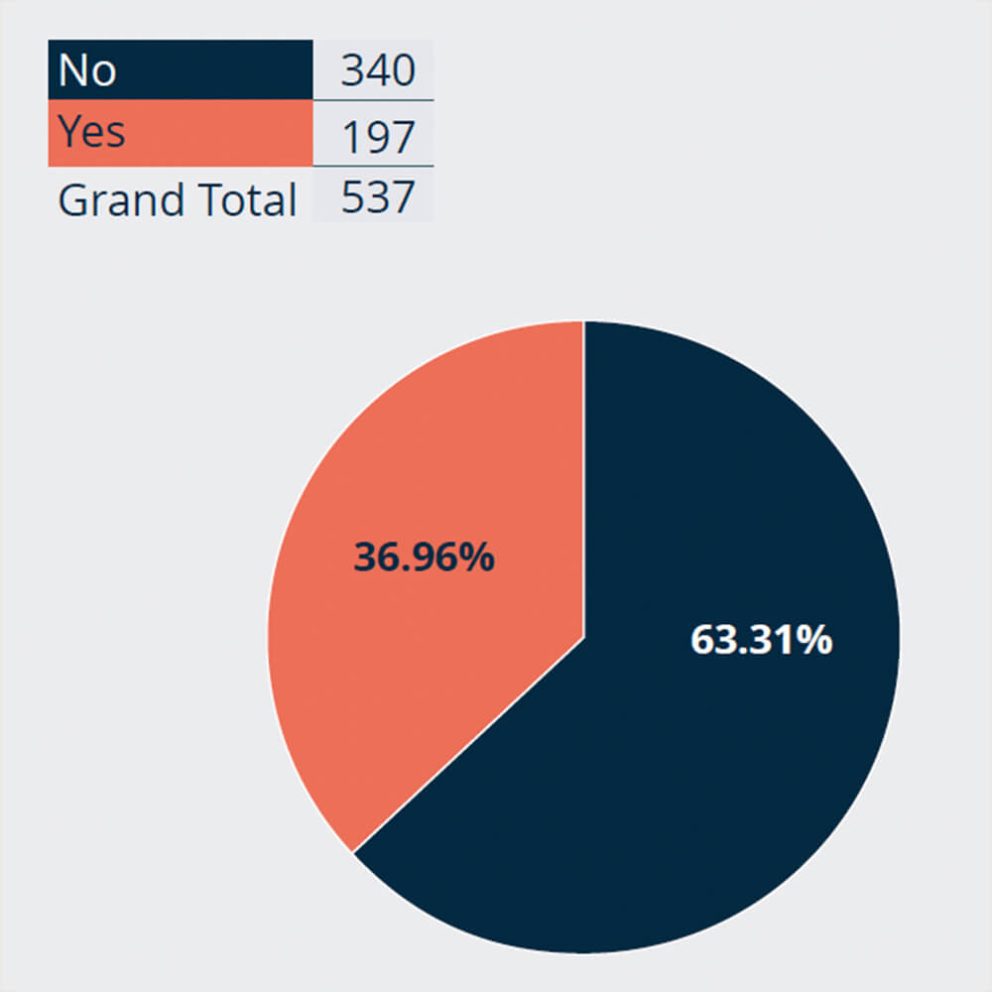
More than a third of the experts responding to this question said they had experienced hired gun experts in their field in the past year. This remains a concern and can prove difficult for an expert if the expert on the other side is behaving like a hired gun. When the other expert provides evidence that in effect shows that they are looking for evidence to substantiate the opinion preferred by the instructing party, rather than looking at the circumstances and evidence as a whole to come to an independent view, then you must be particularly thorough in the methodology that you use and set out clearly how you came to your informed opinion.
Any expert that notices this happening should notify the instructing solicitors, and counsel may be able to reveal the bias in cross examination. It is also important to understand why an expert appeared to be behaving this way. Was it deliberate on the part of the expert in question, or was it through lack of understanding of the role? Were they poorly briefed, or under pressure from the instructing solicitor?
Have you come across an expert witness in the last year who you feel is compromised due to a conflict of interest?

Just less than a quarter of respondents said that they had come across an expert in the last year who they felt was compromised due to a conflict of interest. This was the situation in the Post Office enquiry, where it was suggested that one expert did have such a conflict. Clearly, when exercising due diligence in the selection of an expert, solicitors must make sure that there are no conflicts of interests. Again, this can be revealed in cross examination and even earlier in discussions.
Reflecting on conflicts of interest, one survey respondent said: “I have increasingly been approached by agencies who try to impose significant control over your fees and methods of working in return for instructions. I feel this is entering the realm of conflict of interest and the agencies starting to dictate what and who they instruct – bringing in the hired gun issue. It is much cleaner when the expert can work directly with the solicitor in an open and professional manner. As long as the expert understands their role and the solicitor respects it, then things work well. Third parties muddy the water.”
Have you come across an expert witness in the last year who you feel hasn’t possessed the qualifications and experience appropriate to the dispute in which they are acting?
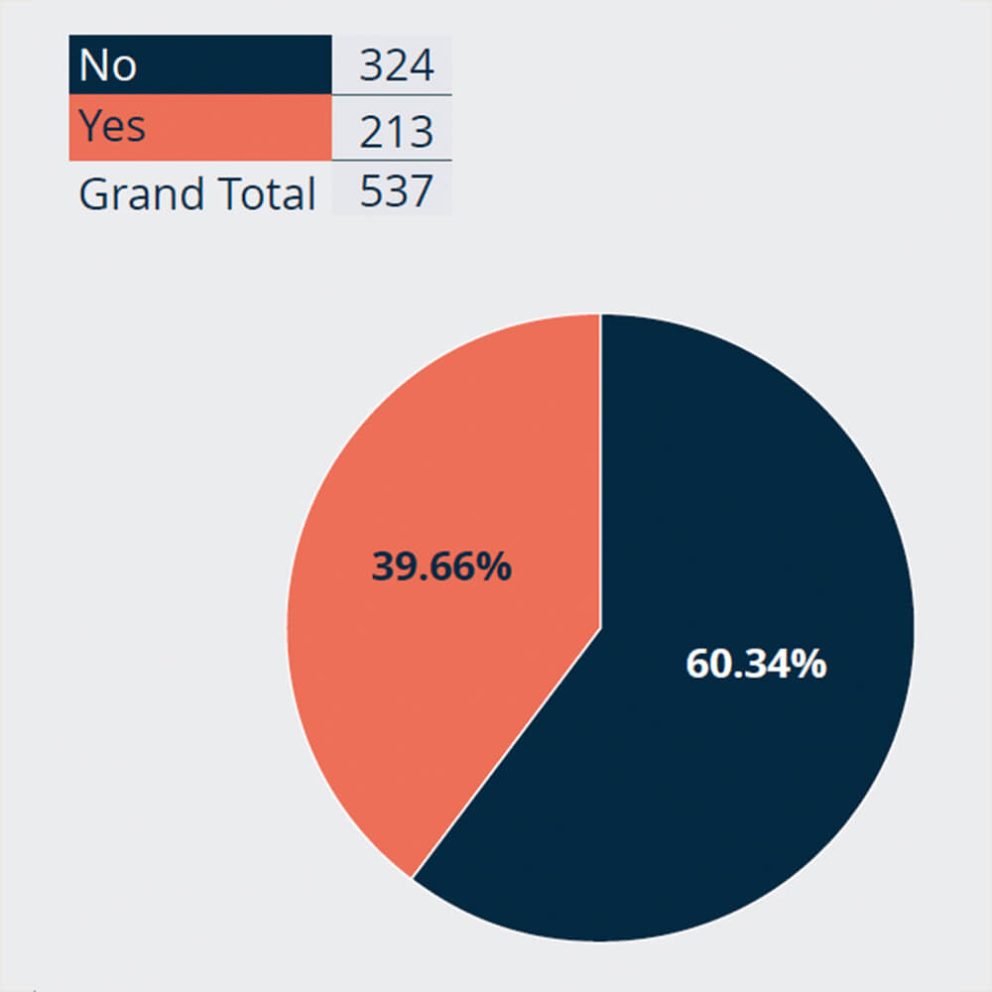
A significant number of respondents said that they had come across experts who didn’t have the right qualifications and experience appropriate to the issues in dispute. It is important that solicitors make sure that an expert has the right qualifications and experience relevant to the issues in dispute before instructing them. The expert witness’s CV is often the first thing attacked in cross examination, and it is better that the right expert is instructed from the start.
The courts appear more ready to impose sanctions on experts either directly through cost orders, criticism, or by excluding their evidence.
Do you think the potential sanctions that experts could face is putting them off accepting instructions?
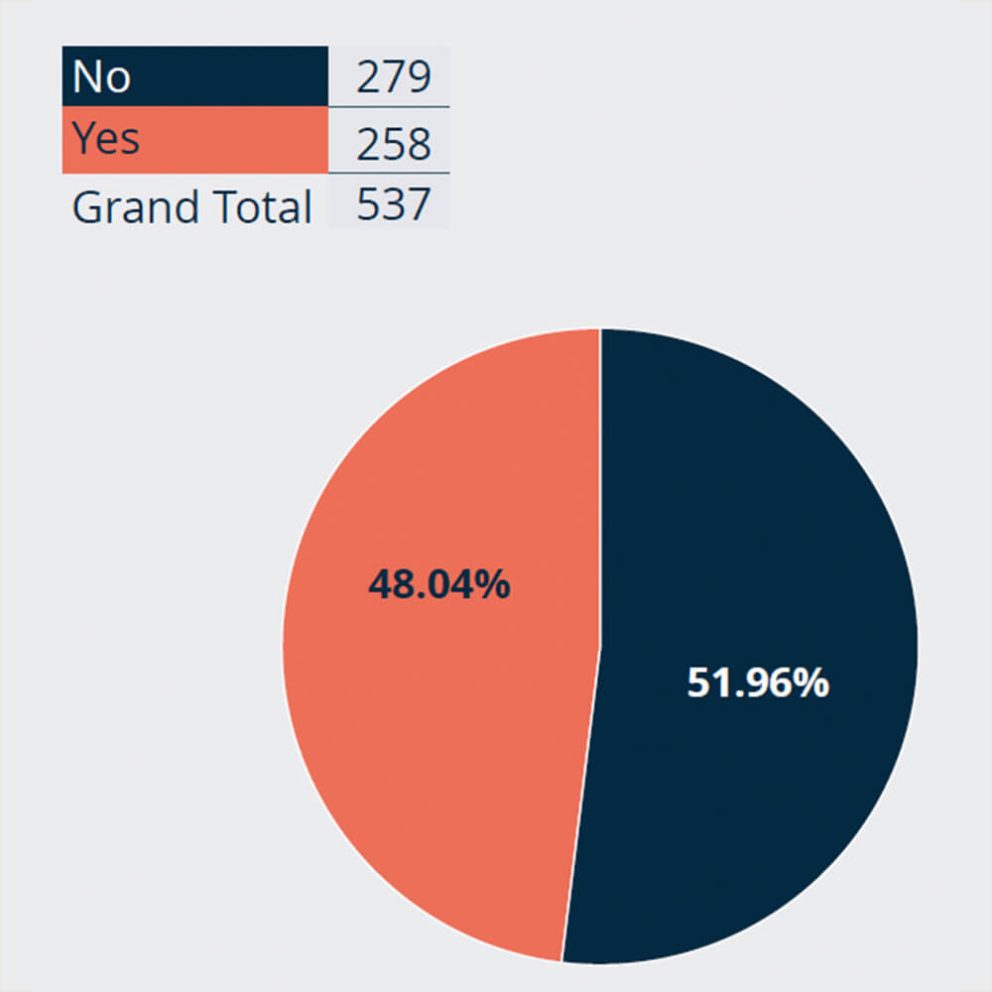
The respondents were split in terms of thinking that experts could be put off accepting instructions because of potential sanctions. There are several options for sanctions that come to mind, including the awarding of costs, reputational damage, disciplinary proceedings and even litigation against an expert witness. Sanctions should be considered by an expert before accepting instructions to ensure that they act professionally and, if necessary, reject instructions where they are not the right expert for the job.
Do such sanctions improve standards?

Around two thirds of experts thought that sanctions do improve standards, as a stick not a carrot.
Expert Witness work can be quite an isolated profession and levels of support and guidance vary from profession to profession.
Do you think that a formal mentoring scheme for expert witnesses, with an accredited provider, would help improve standards?

The majority of respondents thought a formal mentoring scheme for experts with an accredited provider would improve standards. It may be difficult to create a system where such mentoring could take place both from a logistical and costs point of view, however the response to this question suggests it’s worth exploring further. Just under a quarter of respondents did not think that a formal mentoring scheme would improve standards. Some of these may have been concerned that mentoring may be regarded as interference with the opinion and could verge on coaching. It is important to make a distinction between the two practices, with mentoring focused on improving access to the expert witness profession and knowledge sharing on how to perform the role well, rather than coaching expert evidence itself.
One respondent commented: “Proper mentoring is very important – not just in report writing, but how to present evidence in court; how to avoid cross-examination faux pas; dealing with aggressive opposing counsel.”
Would you personally like to be mentored if such a mentoring scheme were to exist?

Around half the experts who responded said that were there to be such a mentoring scheme, they would like to be a part of it. If such a scheme existed, there would need to be carefully drafted rules in place to ensure objectivity and that there was no part of the mentoring referring to an actual forthcoming matter in accordance with decided cases.
In civil cases it is very common for experts to be instructed pre-action.
Has it always been made clear to you that the report is pre-action?

Around a quarter of the respondents said that instructing solicitors had not made it clear to them that in civil cases the expert was being instructed pre-action. Of course, instructing solicitors should make it clear the purpose of any instructions and at what point the instructions are given during the lead up to litigation or after litigation was in progress.
Is your experience that lawyers instructing you pre-action want to pay as little as possible for as much as possible to determine the merits of their client’s case?

It is interesting that around half the respondents said that instructing solicitors wanted to pay as little as possible for a pre-action report. Perhaps this is understandable as the instructing solicitor and their clients are still deciding what further action to take. This shows the great importance of a pre-action report, which might steer the client and instructing solicitors towards settlement, taking action, or even taking no further action. Such reports should therefore be paid at the right rate. Clear terms and conditions agreed between the instructing solicitors and expert should help avoid such problems.
In recent times there have been cases where experts have claimed not to understand their duties and responsibilities as an expert witness.
Have you come across an expert witness in the last year who you feel hasn’t understood their duties and responsibilities, and the law and procedure governing their work?

Around a third of experts said that they had come across experts in the last year who they felt did not understand the duties and responsibilities, or the law and procedure governing their work. Such understanding is absolutely vital, and it is astonishing that some experts do not have that understanding. This confirms the necessity of proper training to be an expert witness as the skills and knowledge required are different to those required for work in the expert witnesses’ professional work.
There have been several cases over recent years where this lack of knowledge and understanding has become apparent during the proceedings and has been commented on by the judge. As mentioned above, instructing solicitors must themselves make sure before instructing an expert that the expert, as well as being appropriate to the issues in dispute, also understands the role of the expert witness.
Should instructing solicitors be under a specific duty to make sure that expert witnesses understand their duty to the court?

Following on from the response to question 10, a large majority of experts thought that instructing solicitors should be under a specific duty to make sure that the expert understands the duty to the court. Such a new specific duty would need to be required by appropriate court and professional rules. There would also need to be a clear definition of what that duty means.
Have you faced undue pressure from instructing solicitors to change your opinion in the last year?
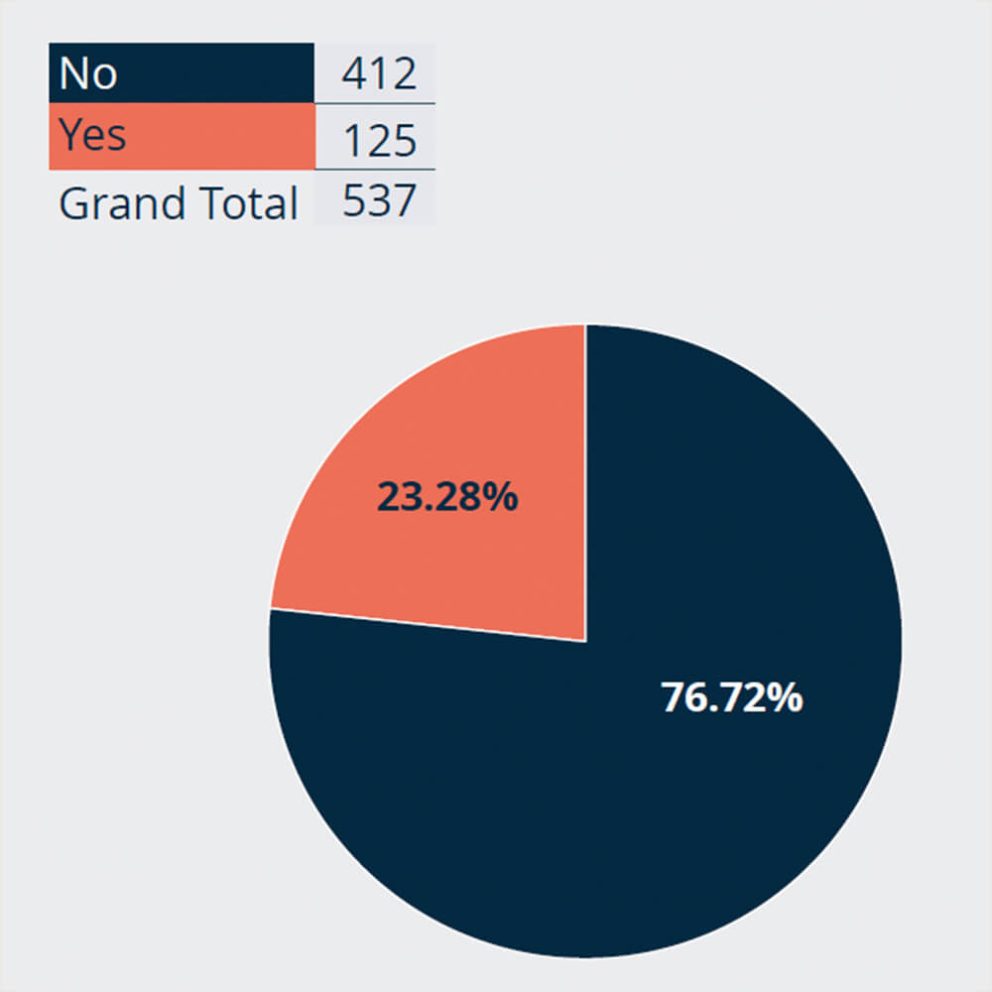
Although the number of experts responding that they faced undue pressure from instructing solicitors to change their opinion has reduced since the previous survey, still around a quarter say they have faced such pressure. This is of concern. There is a need now for instructing solicitors to really understand that an expert witness is not an adversarial tool, as described in Lord Woolf’s report Access to Justice, but the expert is a professional there to assist the court to come to the right decision. Instructing solicitors can, of course, press an expert to explain their methodology and reasons for coming to a particular opinion and this can be quite vigorous. However, such pressure should not move into the realms of undue pressure to change an opinion. It can only be used to ensure that the expert opinion is robust and well considered.
One respondent to the survey said: “I have been placed under pressure to change my findings in a case. The solicitor became abusive and was sending me abusive emails. This is not however in the past year. I ended my involvement with them, which led to more abuse. I did not know whether to report this or who to report it to”
Another said: “Although I have not acted on any cases in the last 12 months, I feel there is more (unfair) pressure by solicitors to provide a report with their aims in mind.”
Do you think there should be stronger sanctions against solicitors who intentionally lead experts to breach their duty to the court?

Experts overwhelmingly thought that there should be stronger sanctions against solicitors who intentionally lead experts to breach their duty to the court. Perhaps the strongest of the sanctions more often used is that of costs imposed by the judge. There is also the chance of contempt of court proceedings against an expert who makes a false statement in the verified report, without believing it to be true; any expert found in contempt of court for that reason will be sent to prison, following the Liverpool Victoria Insurance v Zafar 2019 case.
Reflecting on this question one respondent remarked: “Do I think leading solicitors should be penalised more? No, not ‘more’ – they should be given a penalty. But I don’t consider the present system broken. Overall, my feedback is that I have seen EWs who present in a manner to best represent their client (not court/inquiry). In such cases the inquiry chairperson/cross barrister has not pulled them up on bias. This appears common in my experience of the year to date.”
Do you think there should be a specific system for experts to notify the Solicitors Regulation Authority of problems between experts and solicitors?

The vast majority of experts thought that there should be a specific system for experts to notify the Solicitors Regulation Authority (SRA) of problems between experts and solicitors. There is provision within the court rules for an expert to go to the judge in a matter, but the SRA could play a bigger part. It seems many experts do not know how to approach the SRA for assistance or what assistance the SRA could give.
One respondent said: “I feel strongly that there should be a clear focus on the conduct of the lawyers. Medical experts are doing their best and should not be placed under pressure by the lawyers, who appear never to be criticised. The whole system of PI and medical CN should be reformed to have panels of three medics and one lawyer to review cases, apportion quantum, and identify learning. The adversarial system does not work well.”
In some jurisdictions, the courts will select and appoint the expert witness, but the parties may make suggestions or may object to the appointment of certain experts if they can demonstrate that a specific expert may be biased.
See: https://www.germancivilprocedure.com/testimonyand- evidence-in-german-civil-litigation/
Do you think such a system would improve standards here if adopted as part of the English legal system?

Interestingly, a slightly larger proportion of experts thought that a new system whereby the courts select and appoint expert witnesses could be adopted under the English legal system. This would require substantial work to create such system. The Ministry of Justice and the judiciary would consider what would be the benefits and would they outweigh the costs and potential downsides in amending the long-standing adversarial system.
One respondent said: “I would support the use of single joint experts. However, I would be wary of such experts being appointed by the courts. The risk of the “old boy’s network” taking over and locking out new opinion or younger talent is considerable”.
Another commented: “Really keen to understand the work that is done to improve standards BUT also to improve the process for appointing experts because often we are appointed at the last minute and need to rush things which may lead to mistakes.”
“Lawyers should also consider appointing consulting experts more often because I believe a lot of time and cost could be saved where a consulting expert can provide guidance on the strengths and weaknesses of a case which may ultimately lead to there being no need to appoint an independent expert witness.”
Artificial intelligence is being used in diverse ways.
Have you used artificial intelligence to assist you in your work as an expert witness?

The vast majority of experts have not used artificial intelligence (AI) to assist them in their work. This is perhaps surprising as AI is being introduced in many professional fields.
In what areas of your expert witness work have you used artificial intelligence?
Are you concerned that the use of AI will lead to a reduction in your fees?

Experts seem unconcerned that AI will lead to a reduction in fees. It may be that we are still at a very early stage in the adoption of AI generally and that it is now too early to say the effect on experts’ fees and work.
Are you concerned that the use of artificial intelligence will lead to a reduction in the need for your services as an expert witness?
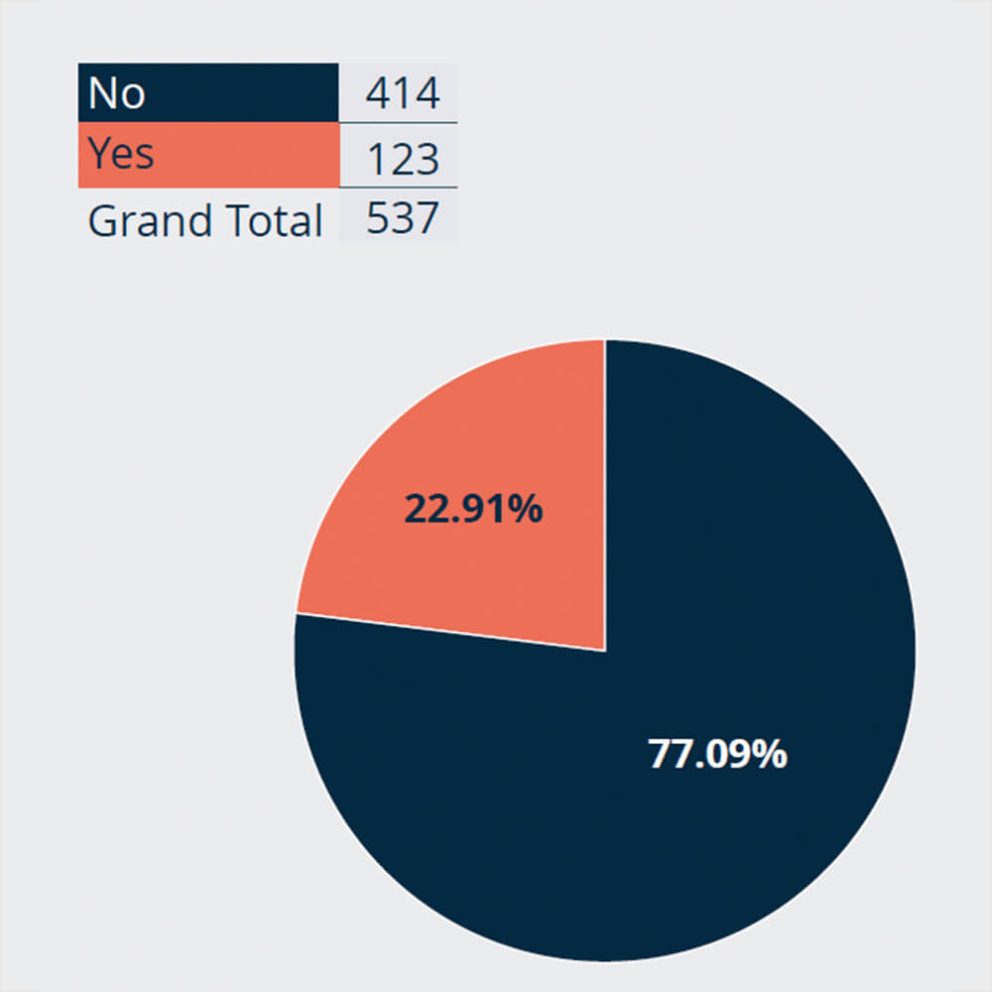
Only around a quarter of experts are concerned about AI leading to a reduction in the need for expert witness evidence. It is more likely that AI will be used as a tool by experts in the preparation of an expert witness report. Questions will arise as to how that use should be revealed in the report so the court can decide on what weight to give to the methodology used to come to an opinion.
Should there be a presumption that expert evidence should be given remotely unless there are good arguments made that require the expert to attend in person?

Post covid, the use of remote evidence giving has increased substantially and around two thirds of experts think that there should be a presumption that expert evidence should be given remotely. There are many benefits of giving evidence remotely, but many people involved have said that watching evidence being given on a monitor is not the same as the witness giving evidence in person.
One respondent said: “Expert witnesses as a servant to the court, need to be present throughout the hearing, and therefore required to give their evidence in person. Virtual attendance misses salient information that may be relevant, and require re-evaluation of your expert opinion, that may be otherwise missed (or not available) online.”
One of the most common questions we get asked, often on a daily basis, is what fees experts should be charging and what fees are considered competitive/market rate for their specialism. This of course depends on many factors such as seniority, type of expertise and years of experience as an expert witness.
How many years have you practised as an expert witness?

Do you work in the medical/healthcare field?

From the list below, please select the option that best describes your area of specialism.
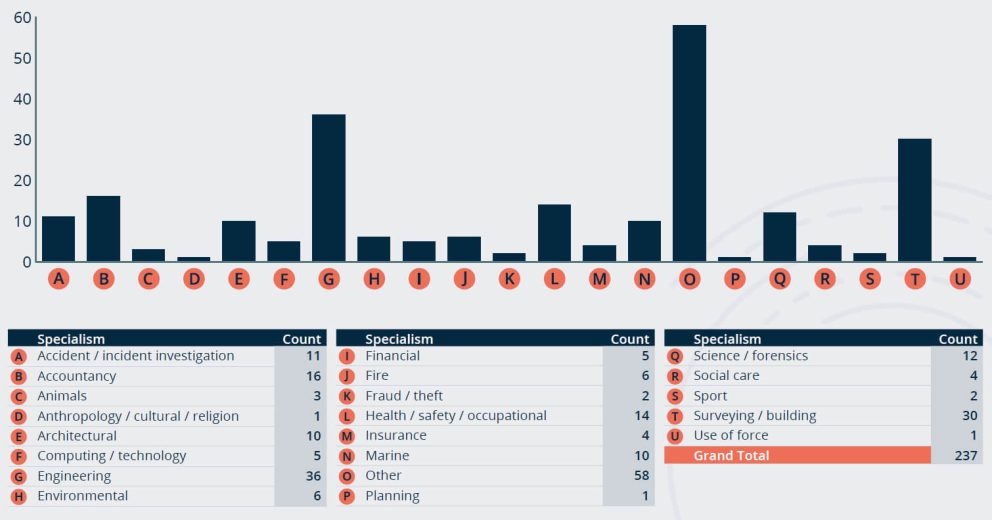
From the list below, please select the option that best describes your area of specialism.
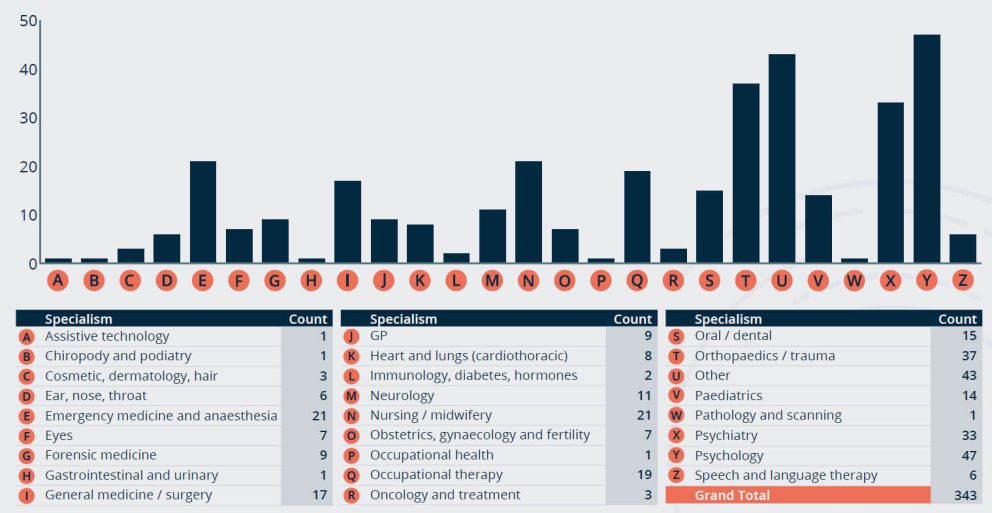
What legal forum(s) do you operate in? (Select all that apply)

What is your average hourly rate?
If you charge different fees for the type of expert witness work you are performing (e.g. report writing, court hearings, conferences with counsel, discussions with experts), please just give an estimate of your average hourly rate. See appendix 3.
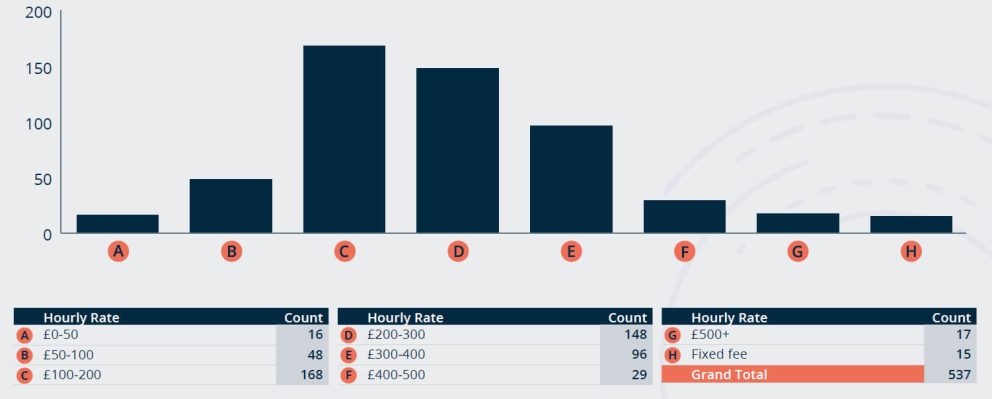
How does this compare to your fees 12 months ago?

Is there anything else you would like to add on this subject?
Fees invited numerous responses from experts who are disgruntled by the downward pressure on fees, low rates of legal aid pay, and solicitors not paying promptly.
One said: “Something seriously needs to be done to break solicitors out of their institutional refusal to follow previously agreed terms of engagement and pay their experts on time. I’m absolutely sick of chasing them, if they’re not rude and arrogant, they’re completely uncommunicative, it simply isn’t good enough. We have a business to run and timely payment is critical to its cashflow and viability. If solicitors can’t get a grip of this then the LAA must, it’s pathetic.”
The amount of time taken to pay was highlighted time and again as an issue which causes considerable stress, wasted time chasing payments and cash flow issues. A few respondents said they had started asking for deposits because the “recovery of fees remains a problem”, or in another’s words had become “maddening”.
One respondent suggested: “There needs to be a better system of accountability when law firms fail to pay fees due to experts.”
Another said: “I always insist on being paid by the insurance company on a monthly basis. I won’t take on work where solicitors are paying my fees.”
Reflecting on legal aid pay, one respondent queried the need for a difference in rates of pay in London, and outside of it.
Another said: “Legal Aid hourly rate of £180 is low and has not been revised for 20 years. Defence experts can expect twice as much which is inequitable.”
“It is becoming increasingly difficult to justify accepting legal aid funded cases,” said another, “due to the restriction of the fees and the amount of time it takes to receive payment”.
Question 17: In what areas of your expert witness work have you used artificial intelligence?
Question 26: If you answered Other to the previous question, please specify. What legal forum(s) do you operate in?
Question 28: Please give an estimate of your hourly rate.
Question 30: Is there anything else you would like to add on this subject?